

BIO5 Institute celebrates 25 years of transformative research
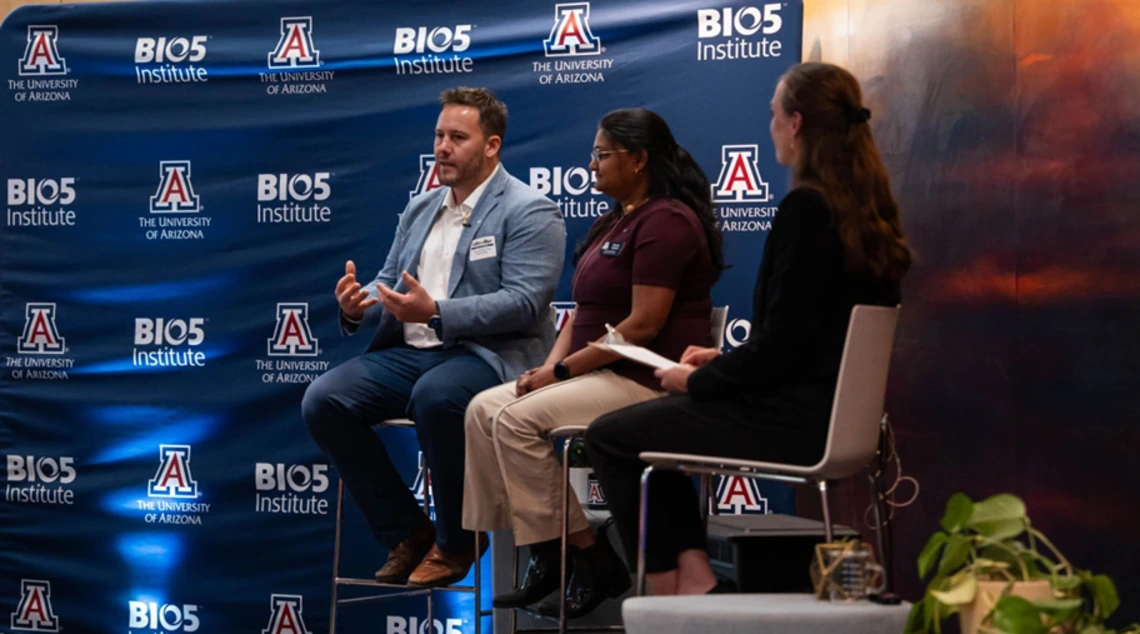
Alex McGhee (left) and Swarna Ganesh (right) are combining their complementary bioengineering approaches to make organoid models more consistent, scalable and useful for studying disease.
Lily Howe, BIO5 Institute
Since the BIO5 Institute opened its doors 25 years ago, University of Arizona faculty have made crucial improvements to medical instruments and processes that could prolong human life.
Swarna Ganesh and Alex McGhee, both assistant professors of biomedical engineering and BIO5 faculty members, are building 3D models of human tissue, organoids that more closely reflect how the body works. For decades, researchers relied on simplified systems or animal models. But those approaches don’t always translate to human biology, especially for complex systems like the immune response.
Organoids can change that.
Ganesh’s lab uses light-based printing to create structures where cells can grow into functional tissue.
“What this gives us is control," she said. "We can decide how cells are arranged and how they interact, which means we can start asking much more specific questions about disease."
That level of control makes more advanced experiments possible.
McGhee’s lab approaches the problem differently, focusing on how cells can build and organize those structures themselves, creating systems that evolve. The two approaches make it possible to design experiments that neither could do alone.
“We can take a patient’s cancer, place immune cells near it and watch how those cells behave over time,” McGhee said. “Then we can start to ask what makes one cell effective at killing cancer while another ignores it.”
That question, why one cell responds and another doesn’t, is difficult to ask in traditional models. In a system built from a patient’s own cells, it becomes possible to observe those differences.
Together with support from BIO5, Ganesh and McGhee are working to make organoids consistent, scalable and accessible so they can be used reliably across labs as tools for testing drugs and studying disease.